I hope everyone had a good Thanksgiving. As a reminder, today is Buy Nothing Day. Much more than a show of consumer solidarity and conciousness, it is a time for people to reflect on how they live their lives. Many of us, driven by effective advertising, live life always wanting more and more "stuff". This consumerism not only generates extreme waste and hurts the environment, but it also distracts people from the important things in life, from spending time with friends and family to being politically active and wanting to create a better world for our children than we currently live in. It is hoped that by having a day like this, people will alter their habits over the course of the entire year, if only slightly.
Here are some videos for Buy Nothing Day (the first video is from a previous year so the date mentioned is incorrect).
Friday, November 24, 2006


Wednesday, November 22, 2006
On the Nonexistence of Free Will
If you look up free will in the dictionary, you will get this definition
Can the definition be any more condemning? Action independent of external causes?! This means that free will is incompatible with the principle of causality. In the physics community, we quickly toss away theories that are non-causal. If events do not have a cause, then you cannot predict them. They are, in effect, supernatural events. In fact, it hard to think of a scenario where one could argue for having free will without believing in some sort of supernatural "spirit" or "soul" that isn't affected by natural events.
Now someone might say "quantum mechanics has shown us that we cannot always predict what will happen with absolute certainty, perhaps this leaves room for free will?". This is a good try, but it still doesn't cut it. It's true that in modern physics things cannot be predicted with absolute accuracy, but we can predict probabilities of events occuring. So in principle, I could compile all events that happened in your lifetime into a huge computer, complete with all genetic information that may be relevant, and if I knew what events you would later observe I could predict the probabilities of you doing certain actions and of your brain generating certain thoughts. Sure, it would take a huge amount of computing power and a great deal of initial data to compute these probabilities, but they could be computed in principle, and that is all that is necessary to invalidate the idea of free will.
The ambitious atheist might try to conclude that that absence of free will completely destroys the idea of ChristianTM morality because if humans don't have free will, then they cannot choose their life and it makes no sense to punish nor reward them for their actions as Christian dogma describes. But I have to say, for the sake of intellectual honesty, that I don't believe my argument applies to Christianity in this way, or any other religion for that matter. The reason for this is that Christians, for example, presuppose the existence of a supernatural realm, and who is to say that the principle of causality applies in that realm? Christians actually believe in souls, spirits, angels, and demons. So it's quite easy to see how a Christian might be able to argue that the supernatural realm is non-causal. However, if they do so, some of their ideas of God, particularly those which are related to his anthropomorphic character, are bound to fall apart. For example, if God lives in the supernatural realm, and is a non-causal being, then why should one pray to him? Your prayers don't necessarily cause him to think about your situation, because his processes are not caused by external events! Any story from the Bible where God reacts to earthly events also becomes suspect, since the supernatural world is not causal. The Christian may then argue that some aspects of the supernatural are causal, while others are not. And it's obvious that the things which are causal and those which are non-causal will depend on what it needs to be to be consistent with his worldview. I guess that's the convenience with believing in a magical world where anything goes and one can simply wish it to be true and it is....
Outside of religious debates, what significance does the absence of free will mean to the normal person? For one, it's something that must be kept in mind when one considers the concept of justice. If people do not actually make choices in a free manner, it makes no sense to punish them for their "wickedness". Instead, one must look for the causes of bad behavior and think about logical ways to prevent it from happening in the future.
I personally am not concerned with my lack of free will. My choices and thoughts are determined by the experiences I've had in my life, and that's all that I need, not to mention the only thing that makes sense to me.
freedom of self determination and action independent of external causes
Can the definition be any more condemning? Action independent of external causes?! This means that free will is incompatible with the principle of causality. In the physics community, we quickly toss away theories that are non-causal. If events do not have a cause, then you cannot predict them. They are, in effect, supernatural events. In fact, it hard to think of a scenario where one could argue for having free will without believing in some sort of supernatural "spirit" or "soul" that isn't affected by natural events.
Now someone might say "quantum mechanics has shown us that we cannot always predict what will happen with absolute certainty, perhaps this leaves room for free will?". This is a good try, but it still doesn't cut it. It's true that in modern physics things cannot be predicted with absolute accuracy, but we can predict probabilities of events occuring. So in principle, I could compile all events that happened in your lifetime into a huge computer, complete with all genetic information that may be relevant, and if I knew what events you would later observe I could predict the probabilities of you doing certain actions and of your brain generating certain thoughts. Sure, it would take a huge amount of computing power and a great deal of initial data to compute these probabilities, but they could be computed in principle, and that is all that is necessary to invalidate the idea of free will.
The ambitious atheist might try to conclude that that absence of free will completely destroys the idea of ChristianTM morality because if humans don't have free will, then they cannot choose their life and it makes no sense to punish nor reward them for their actions as Christian dogma describes. But I have to say, for the sake of intellectual honesty, that I don't believe my argument applies to Christianity in this way, or any other religion for that matter. The reason for this is that Christians, for example, presuppose the existence of a supernatural realm, and who is to say that the principle of causality applies in that realm? Christians actually believe in souls, spirits, angels, and demons. So it's quite easy to see how a Christian might be able to argue that the supernatural realm is non-causal. However, if they do so, some of their ideas of God, particularly those which are related to his anthropomorphic character, are bound to fall apart. For example, if God lives in the supernatural realm, and is a non-causal being, then why should one pray to him? Your prayers don't necessarily cause him to think about your situation, because his processes are not caused by external events! Any story from the Bible where God reacts to earthly events also becomes suspect, since the supernatural world is not causal. The Christian may then argue that some aspects of the supernatural are causal, while others are not. And it's obvious that the things which are causal and those which are non-causal will depend on what it needs to be to be consistent with his worldview. I guess that's the convenience with believing in a magical world where anything goes and one can simply wish it to be true and it is....
Outside of religious debates, what significance does the absence of free will mean to the normal person? For one, it's something that must be kept in mind when one considers the concept of justice. If people do not actually make choices in a free manner, it makes no sense to punish them for their "wickedness". Instead, one must look for the causes of bad behavior and think about logical ways to prevent it from happening in the future.
I personally am not concerned with my lack of free will. My choices and thoughts are determined by the experiences I've had in my life, and that's all that I need, not to mention the only thing that makes sense to me.
Wednesday, November 15, 2006
Friday, November 10, 2006
Voices of a People's History of the United States
I just got back from a live reading of excerpts from Howard Zinn's book Voices of a People's History of the United States . Amazon's book description is
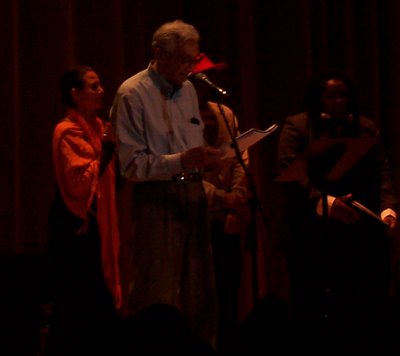
The excerpts were read by a large collection of very good speakers, including Alice Walker, Steve Earle, Mos Def, Melanie Demore, Aya de Leon, Nora el Samahy, Luis Valdez, John Trudell, Anthony Arnove (the book's co-author), and Howard Zinn himself. Despite there being a couple thousand people there, I got a very close seat. Below is a picture I snapped of Zinn towards the end.
I didn't even know that this was going to happen until lunchtime today, when I was fortunate enough to have to go to the restroom and there discovered this event being discussed in the paper. I'm glad I found out. It was by far the best live event I've ever been to. Two hours straight of extremely powerful and moving material. I believe my favorite part was a reading of an editorial from the abolitionist newspaper North Star called "The War With Mexico". I wish I had the full excerpt, but I'll have to deal with the only part I could find online.
This is the tail end of what was said. But by the end of the bolded part, the entire audience saw that that was exactly the situation we faced today and broke out into applause. If they didn't understand it before, then after this the entire audience must have finally understood why historians say that history repeats itself. It was truly an awesome moment, and similar moments occured throughout the rest of the night as events from the past were almost identical to those today except for changes in names.
Everyone's readings were great though. Mos Def was absolutely fantastic as Malcolm X! Probably the best part of the night was a contribution from the Vanguard Public Foundation (not in anyway related to the trading company) which paid for 500 high school students to come to the event. The event must have made a large impact on many of them that will shape their outlook on the world for the rest of their life.
If anyone has the chance to go to this sometime, you really should. I also plan on buying the book. I won't be able to read it for awhile, but it looks like it will be a great reference for my personal library.
. Amazon's book description is For Voices, Zinn and Arnove have selected testimonies to living history-speeches, letters, poems, songs-left by the people who make history happen, but who usually are underrepresented or misrepresented in history books: women, Native Americans, workers, blacks and Latinos. Zinn has written short introductions to the texts, which themselves range in length from letters or poems of less than a page to entire speeches and essays that run several pages and longer. Voices of a People's History is a symphony of our nation's original voices, rich in ideas and actions, an embodiment of the power of civil disobedience and dissent, wherein lies our nation's true spirit of defiance and resilience
The excerpts were read by a large collection of very good speakers, including Alice Walker, Steve Earle, Mos Def, Melanie Demore, Aya de Leon, Nora el Samahy, Luis Valdez, John Trudell, Anthony Arnove (the book's co-author), and Howard Zinn himself. Despite there being a couple thousand people there, I got a very close seat. Below is a picture I snapped of Zinn towards the end.

I didn't even know that this was going to happen until lunchtime today, when I was fortunate enough to have to go to the restroom and there discovered this event being discussed in the paper. I'm glad I found out. It was by far the best live event I've ever been to. Two hours straight of extremely powerful and moving material. I believe my favorite part was a reading of an editorial from the abolitionist newspaper North Star called "The War With Mexico". I wish I had the full excerpt, but I'll have to deal with the only part I could find online.
We have no preference for parties, regarding this slaveholding crusade [here he refers to the Mexican-American war (1848)]. The one is as bad as the other. The friends of peace have nothing to hope from either. The Democrats claim the credit of commencing, and the Whigs monopolize the glory of voting supplies and carrying on the war; branding the war as dishonorably commenced, yet boldly persisting in pressing it on
This is the tail end of what was said. But by the end of the bolded part, the entire audience saw that that was exactly the situation we faced today and broke out into applause. If they didn't understand it before, then after this the entire audience must have finally understood why historians say that history repeats itself. It was truly an awesome moment, and similar moments occured throughout the rest of the night as events from the past were almost identical to those today except for changes in names.
Everyone's readings were great though. Mos Def was absolutely fantastic as Malcolm X! Probably the best part of the night was a contribution from the Vanguard Public Foundation (not in anyway related to the trading company) which paid for 500 high school students to come to the event. The event must have made a large impact on many of them that will shape their outlook on the world for the rest of their life.
If anyone has the chance to go to this sometime, you really should. I also plan on buying the book. I won't be able to read it for awhile, but it looks like it will be a great reference for my personal library.
Wednesday, November 08, 2006
Vermont Elects First Socialist to Senate/Ralph Nader's Analysis of Election Results
Democracy Now! had two good segments on their show today that I thought were worth watching relating to yesterday's election. The first is an interview with Vermont's Bernie Sanders, who yesterday became the first socialist to ever get elected to the Senate. He talks about his campaign and explains what "socialism" means to him. The second part is Ralph Nader giving his analysis of the election results. He talks about the likelihood of the Democrats solving the main problems that our country faces. The video is here. What I'm referring to starts at the 18:18 mark.
How is everyone feeling about the election yesterday? Are you happy with the results, or were you disappointed? Do you think the Democrats will do much now that they have power? If so, what and how soon?
How is everyone feeling about the election yesterday? Are you happy with the results, or were you disappointed? Do you think the Democrats will do much now that they have power? If so, what and how soon?
Monday, November 06, 2006
Get Out and Vote Tomorrow
Tomorrow is Election Day, that one day that comes around every 2 years when our government is forced, both by tradition and the need to keep up appearances, to give us some sort of input into how our country is run.
Do I think much comes out of elections? Not really. Looking at the slate of candidates quickly lets one know that the people have already lost. You don't even have to have radical politics to think this. "The lesser of two evils" is sadly a very commonly spoken phrase in our country nowadays. But having said that, I think good things can come out of elections. Firstly, if you can vote directly on propositions then you have a rare opportunity to have your voice heard. In California we have two propositions (87 & 89) that would be worth passing. Prop 87 raises taxes on oil companies to help fund alternative energy, while Prop 89 establishes some sort of public financing of campaigns which will enable third-party candidates to spread their message to a wider group of people. Unfortunately I've heard that due to a large misinformation campaign funded by Chevron that Prop 87 is behind in the
polls. Just goes to show that even when democratic structures are in place, that differences in economic power can easily translate themselves into political power. But at least we have the opportunity to vote on it.
For the most part I believe that elections are purely symbolic, and basically serve as a poll of public opinion. That is why I vote for candidates whose policies I support (as much as possible), and refuse to vote for the "lesser of two evils". While I'm certain that none of the candidates outside city-wide office that I voted for (I voted early) will win, I look forward to seeing how many like-minded individuals there are out there and to draw some hope for the future from a good showing. In addition, I think voting for parties that are on the left (such as Peace and Freedom, or the Greens) is the best way to prevent the country from right-wing policies. When people vote for the Democrats because they are afraid of Republicans coming into office, it gives the Democratic party little reason to not drift further to the right. And they will, since that's where the money and media power is. But voting to the left of them gives them a reason to remain progressive, in the hopes that they might be able to pick up those leftist votes in the next election. It's like if you have a new puppy that isn't housebroken yet. While you certainly prefer that he shits on the tile kitchen floor (the Democrats) rather than shit on the white carpet (the GOP), you certainly don't give him a treat when he goes to town near the kitchen table.
Anyway, go out and vote. Tuesday night I might be at a local bar with the Green party candidates for Governor, Secretary of State, and Senator. If I get a picture with them I'll put it up. I didn't vote for all 3 of them (Peace and Freedom instead) but they are all progressive individuals and I hope to meet them.
Also, the blog has been a little politics heavy as of late. After reporting on the election results I hope to write a post about free will. Have a good week.
Do I think much comes out of elections? Not really. Looking at the slate of candidates quickly lets one know that the people have already lost. You don't even have to have radical politics to think this. "The lesser of two evils" is sadly a very commonly spoken phrase in our country nowadays. But having said that, I think good things can come out of elections. Firstly, if you can vote directly on propositions then you have a rare opportunity to have your voice heard. In California we have two propositions (87 & 89) that would be worth passing. Prop 87 raises taxes on oil companies to help fund alternative energy, while Prop 89 establishes some sort of public financing of campaigns which will enable third-party candidates to spread their message to a wider group of people. Unfortunately I've heard that due to a large misinformation campaign funded by Chevron that Prop 87 is behind in the
polls. Just goes to show that even when democratic structures are in place, that differences in economic power can easily translate themselves into political power. But at least we have the opportunity to vote on it.
For the most part I believe that elections are purely symbolic, and basically serve as a poll of public opinion. That is why I vote for candidates whose policies I support (as much as possible), and refuse to vote for the "lesser of two evils". While I'm certain that none of the candidates outside city-wide office that I voted for (I voted early) will win, I look forward to seeing how many like-minded individuals there are out there and to draw some hope for the future from a good showing. In addition, I think voting for parties that are on the left (such as Peace and Freedom, or the Greens) is the best way to prevent the country from right-wing policies. When people vote for the Democrats because they are afraid of Republicans coming into office, it gives the Democratic party little reason to not drift further to the right. And they will, since that's where the money and media power is. But voting to the left of them gives them a reason to remain progressive, in the hopes that they might be able to pick up those leftist votes in the next election. It's like if you have a new puppy that isn't housebroken yet. While you certainly prefer that he shits on the tile kitchen floor (the Democrats) rather than shit on the white carpet (the GOP), you certainly don't give him a treat when he goes to town near the kitchen table.
Anyway, go out and vote. Tuesday night I might be at a local bar with the Green party candidates for Governor, Secretary of State, and Senator. If I get a picture with them I'll put it up. I didn't vote for all 3 of them (Peace and Freedom instead) but they are all progressive individuals and I hope to meet them.
Also, the blog has been a little politics heavy as of late. After reporting on the election results I hope to write a post about free will. Have a good week.
Saturday, November 04, 2006
The British Hate Us for Our Freedom
America is now seen as a threat to world peace by its closest neighbours and allies, according to an international survey of public opinion published today that reveals just how far the country's reputation has fallen among former supporters since the invasion of Iraq.
Carried out as US voters prepare to go to the polls next week in an election dominated by the war, the research also shows that British voters see George Bush as a greater danger to world peace than either the North Korean leader, Kim Jong-il, or the Iranian president, Mahmoud Ahmadinejad. Both countries were once cited by the US president as part of an "axis of evil", but it is Mr Bush who now alarms voters in countries with traditionally strong links to the US
Full article here.
Wednesday, November 01, 2006
We're Not #1? Or Even Top 50?
It's always good to remind people that we can't live in a wonderful country simply by proclaiming that it is so.
Monday, October 30, 2006
World Government
Back when I was in high school, I was a big fan of the idea of having a world government. I thought of all the money, resources, and energy that was dedicated on people spying on each other, fighting each other, and wasting money on military that they purchase in order to ward off an attack by an enemy's arsenal (bought for the same purpose). I remember being a strong advocate of the European Union and wished that someday the US would lose its strong sense of nationalism and would join the EU, centralize its power, and offer economic packages to induce other countries to join. During the summers I worked at Staples (the self-proclaimed Office Superstore), and I remember stocking shelves trying to convince another student who worked there of the benefits of a world government. He objected, on the grounds that the Bible said that a world government would be the first step towards the end times. So you can imagine how productive that conversation was...
My outlook on the world has changed drastically since that time. Probably the biggest difference related to this topic is the idea that the governments of the world aren't actually accountable to their people. That democracy, even in places where it enjoys a formal existence, is merely a sham and is actually controlled by some elite, whether they be of political or economic nature. So with this understanding, I now find the notion of a world government absolutely terrifying.
But that suggests the question, to what extent do we already have a world government? In just about every country in the world the dominant business interests have a huge say in what actions the government takes, and the largest business interests in each country are very often part of large multinationals that exert influence on other governments as well. They are certainly far from being outright dictatorships, but I believe it's certainly arguable that a great deal of the political power in the world is concentrated in the same type of oligarchic structure. Furthermore, that power is becoming more concentrated over time due to natural market forces in addition to other causes such as more effective propaganda tactics and the lack of organized resistance from the people.
This view of the world is certainly a depressing one, and makes radical change seem nearly impossible to achieve on short time scales. Perhaps a gradual dissolution of the current structures from the inside is the only way to go. War or a quick, isolated revolution is certainly out of the question in an age of nuclear weapons. In addition, this view makes the countries which we are supposed to hate (Cuba, Venezuela, North Korea, Iran, etc.) acquire a silver lining. Surely all these countries are run by complete bastards †, but at least they aren't the same bastards. During the Spanish Revolution, the western "democratic" countries refused to sell the Republic weapons ‡ In fact, in some cases they directly helped and supported the fascists (to be covered in a later post). The only country (besides Mexico) that would support the legitimately elected government was Stalin's USSR. You never know when history will decide to repeat itself, and sometimes the enemy of an enemy is a friend.
† Yes, good things can be said about Castro and Chavez. Iran's current situation is due to the United States and Great Britain overthrowing Iran's only democratic government under pressure from the Anglo-Iranian Oil Company (now called BP) in 1953. But these are complex topics worthy of a more dedicated conversation.
‡ Imagine, a democratically-elected government being refused weapons to defend itself from an openly fascist insurgency!
My outlook on the world has changed drastically since that time. Probably the biggest difference related to this topic is the idea that the governments of the world aren't actually accountable to their people. That democracy, even in places where it enjoys a formal existence, is merely a sham and is actually controlled by some elite, whether they be of political or economic nature. So with this understanding, I now find the notion of a world government absolutely terrifying.
But that suggests the question, to what extent do we already have a world government? In just about every country in the world the dominant business interests have a huge say in what actions the government takes, and the largest business interests in each country are very often part of large multinationals that exert influence on other governments as well. They are certainly far from being outright dictatorships, but I believe it's certainly arguable that a great deal of the political power in the world is concentrated in the same type of oligarchic structure. Furthermore, that power is becoming more concentrated over time due to natural market forces in addition to other causes such as more effective propaganda tactics and the lack of organized resistance from the people.
This view of the world is certainly a depressing one, and makes radical change seem nearly impossible to achieve on short time scales. Perhaps a gradual dissolution of the current structures from the inside is the only way to go. War or a quick, isolated revolution is certainly out of the question in an age of nuclear weapons. In addition, this view makes the countries which we are supposed to hate (Cuba, Venezuela, North Korea, Iran, etc.) acquire a silver lining. Surely all these countries are run by complete bastards †, but at least they aren't the same bastards. During the Spanish Revolution, the western "democratic" countries refused to sell the Republic weapons ‡ In fact, in some cases they directly helped and supported the fascists (to be covered in a later post). The only country (besides Mexico) that would support the legitimately elected government was Stalin's USSR. You never know when history will decide to repeat itself, and sometimes the enemy of an enemy is a friend.
† Yes, good things can be said about Castro and Chavez. Iran's current situation is due to the United States and Great Britain overthrowing Iran's only democratic government under pressure from the Anglo-Iranian Oil Company (now called BP) in 1953. But these are complex topics worthy of a more dedicated conversation.
‡ Imagine, a democratically-elected government being refused weapons to defend itself from an openly fascist insurgency!
Thursday, October 26, 2006
Poll on Political Idealogy
I had planned on writing a substantial post tonight but ended up walking around the city with some friends for a few hours instead. So rather than rushing the writing, I'd like to get an idea of what political idealogies you subscribe to. Each category will have a short description (mostly lifted from Wikipedia due to time constraints). If you'd like to elaborate in the comments section, please do. The definitions are perhaps necessarily vague (as specific definitions can get very subjective), so if you're torn in terms of the definition vote based on the other beliefs and connotations that you have with the two choices.
Anarchism-Anarchism is a political theory which aims to create anarchy, "the absence of a master, of a sovereign." In other words, anarchism is a political theory which aims to create a society within which individuals freely co-operate together as equals. As such anarchism opposes all forms of hierarchical control - be that control by the state or a capitalist - as harmful to the individual and their individuality as well as unnecessary.
Christian Democracy-Broadly speaking, Christian Democracy is conservative in regard to moral and cultural issues, and issues of public morality and tradition. It can be described as left-wing insofar as it claims a "strong social conscience", in the sense of emphasizing the alleviation of poverty, the welfare state, and if necessary the restraint of market forces. It may also be seen as liberal insofar as it upholds human rights and individual initiative.
Communism-Communism is an ideology that seeks to establish a future classless, stateless social organization, based upon common ownership of the means of production. Clarification: Please choose this choice if you see a communist society coming into being with a "communist state" as an intermediate step. If you're an anarcho-communist, please choose anarchism.
Communitarianism-Communitarianism as a group of related but distinct philosophies began in the late 20th century, opposing classical liberalism, capitalism, and other similar philosophies while advocating phenomena such as civil society. Not necessarily hostile to social liberalism, communitarianism rather has a different emphasis, shifting the focus of interest toward communities and societies and away from the individual. The question of priority, whether on the individual or community often has the largest impact in the most pressing ethical questions, such as health care, abortion, multiculturalism, and hate speech.
Conservatism-Conservatism is a political philosophy that necessitates a defense of established values or the status quo.
Fascism-Fascism is a radical political ideology that combines elements of corporatism, authoritarianism, nationalism, militarism, anti-anarchism, anti-communism and anti-liberalism.
Feminism-Feminism is a diverse collection of social theories, political movements and moral philosophies, largely motivated by or concerned with the experiences of women. Most feminists are especially concerned with social, political and economic inequality between men and women (in the context of it being to the disadvantage of women); some have argued that gendered and sexed identities, such as "man" and "woman", are socially constructed. Feminists differ over the sources of inequality, how to attain equality, and the extent to which gender and gender-based identities should be questioned and critiqued. In simple terms, feminism is the belief in social, political and economic equality of the sexes, and the movement organised around the belief that gender should not be the pre-determinant factor shaping a person's social identity, or socio-political or economic rights.
Green Politics-Green politics or Green ideology is the ideology of the Green Parties, mainly informed by environmentalism, ecology and sustainable economics and aimed at developing a sustainable society. It is considered by its advocates to be an alternative to socialism, conservatism, and liberalism, although adherents of the traditional ideologies tend to view Greens as representing "one of the others."
Islamism-Islamism is a set of political ideologies that hold that Islam is not only a religion, but also a political system that governs the legal, economic and social imperatives of the state according to its interpretation of Islamic Law. For Islamists, the sharia has absolute priority over democracy and universal human rights.
Liberalism-Liberalism is an ideology, philosophical view, and political tradition which holds that liberty is the primary political value. Liberalism has its roots in the Western Enlightenment, but the term now encompasses a diversity of political thought.
Broadly speaking, liberalism emphasizes individual rights. It seeks a society characterized by freedom of thought for individuals, limitations on power, especially of government and religion, the rule of law, free public education, the free exchange of ideas, a market economy that supports relatively free private enterprise, and a transparent system of government in which the rights of all citizens are protected. In modern society, liberals favor a liberal democracy with open and fair elections, where all citizens have equal rights by law and an equal opportunity to succeed.
Capitalist Libertarianism-Capitalist Libertarianism is a political philosophy advocating that individuals should be free to do whatever they wish with their person or property, as long as they do not infringe on the same liberty of others.
Nationalism-Nationalism is an ideology that holds that a nation is the fundamental unit for human social life, and takes precedence over any other social and political principles. Nationalism makes certain political claims based upon this belief: above all, the claim that the nation is the only legitimate basis for the state, that each nation is entitled to its own state, and that the borders of the state should be congruent with the borders of the nation.
Social Democracy-Social democracy is a political ideology that emerged out of classical socialism in the late 19th and early 20th century. Unlike socialism, social democracy does not seek to dismantle or replace the capitalist system, but instead aims to reform it in order to remove its perceived injustices and to bring about a more equal distribution of wealth. In recent years, many social democratic parties have embraced 'Third Way' ideology.
Socialism-Socialism refers to a broad array of doctrines or political movements that envisage a socio-economic system in which property and the distribution of wealth are subject to social control. As an economic system, socialism is associated with state or collective ownership of the means of production. This control may be either direct — exercised through popular collectives such as workers' councils — or it may be indirect — exercised on behalf of the people by the state. Clarification: While direct control of the means of production is certainly socialism (and in my opinion the only way to truly have socialism), please choose this one if you envision indirect control through a state (a so-called "worker's state" if you like).
Broadly speaking, liberalism emphasizes individual rights. It seeks a society characterized by freedom of thought for individuals, limitations on power, especially of government and religion, the rule of law, free public education, the free exchange of ideas, a market economy that supports relatively free private enterprise, and a transparent system of government in which the rights of all citizens are protected. In modern society, liberals favor a liberal democracy with open and fair elections, where all citizens have equal rights by law and an equal opportunity to succeed.
Thursday, October 19, 2006
Richard Dawkins on the Colbert Report
Richard Dawkins was on the Colbert Report recently promoting his new book The God Delusion.
When I first checked last night it was #2 on Amazon's bestseller list, and it's currently at #3. I'm assuming that it reached the top mark the first day after he appeared on the Colbert Report.It's nice to see atheists and their books being promoted on shows with large audiences. Stephen Colbert and his show continue to play their part in helping to better our country and to give hope for future change. While being an atheist doesn't imply that one's views and actions are going to be progressive, freeing oneself from corrupt and authoritarian religious structures and beliefs is the first step. I personally don't read atheist books anymore, as it seems like a waste of time to read about arguments against something that's comparable to unicorns, but I hope that it makes a positive impact in the lives of those who have and will buy Dawkins' book.
Monday, October 16, 2006
An Introduction to the Spanish Civil War
Hi everyone, I'm sorry for the light posting as of late. I had a momentary spike in my "real life" activity, in addition to being busy during my free time reading the book The Battle For Spainby Antony Beevor, which is an in-depth look at the events during and surrounding the Spanish Civil War. I'm finally done with it, and I'll try to give a brief introduction to what it is and leave specific topics for later posts.
Despite being an extemely interesting period in history, the Spanish Civil War is not all that well known. Perhaps this is because many of the aspects of the winning side, the right-wing nationalists led by the fascist Franco and supported by Hitler and Mussolini, are so similar to many of the ruling or controlling interests in the US. Perhaps it is because the losing side, that of the liberals, socialists, anarchists, and communists, had core values that are much easier for the average person to identify with. Or maybe it was because it was another example where the Church took the complete wrong side, as they openly praised the fascist Franco and took an active role in helping him with his goals whenever it could. Maybe it has to do with the fact that powerful business interests in the US and elsewhere helped Franco overthrow a legitimately elected democratic government. Or perhaps because the United States giving aid to Franco and preventing aid from reaching the Spanish government (despite polls in the US showing overwhelming public support for the left-wing government, henceforth referred to as the Republic), undermines the image of the United States being a warrior for freedom and democracy in the period surrounding World War II. But perhaps I should get started.
The Spanish Civil War began in 1936 and ended in 1939, right before Hitler's invasion of Czechoslovakia. The war began after a new left-wing government was elected in 1936. The government was not revolutionary, but it was concerned with progressive programs for agrarian reform and it was also in favor of the separation of church and state. This last measure was incredibly irritating for the Church of Spain, who had been a major player in the government and had received large subsidies for centuries. Spain was an extemely polarized country between left and right before the election. Beevor describes the campaigning done by the right:
The war started when a group of generals, later to be led by Franco, decided to overthrow the democratically elected government on July 18th, 1936. The right, called the nationalists,
But Beevor also says that
I think the Spanish Civil War is interesting for a few of the following reasons, and I plan to go into more depth on each in the future.
Anarchism in action- Spain had a very large anarchist following, with anarcho-syndicalist trade unions with millions of members. When the nationalists began the coup, the official Republican government was extremely slow in reacting. This prompted the anarchist and socalist trade unions to take control of the situation themselves in many cities, setting up their own revolutionary committees and preventing the rebels from obtaining an immediate victory. Barcelona, one of the centers of revolutionary activity, was described by a journalist as
The anarchists, despite their superior numbers, did not impose their own system on the population though. The anarchist Garcia Oliver described the alternatives :
Many people did join collective ventures during this time though, and agricultural production on collectivized land increased by 20% over what it was previously. Many small farmers who owned their own land also voluntarily joined the collectives. Meanwhile, on the industrial side, production was largely controlled by the unions formed by the workers.
The Support of Fascism by the Church- The Catholic Church was very supportive of the fascists. Whether it was lying to international bodies concerning events, giving the nationalists lists of people who didn't show up to church in order to interrogate and/or execute, lobbying the US government to refuse aid to the Republic and to support Franco, or simply making statements comparing Franco's war to a holy crusade against heathens, this aspect of the Spanish Civil War should be interesting to any atheist who is looking for more examples of the Church supporting oppressive institutions.
The Support of Facism by the first-world "democracies"- Great Britain, the United States, and even France helped to turn events in the nationalists favor. This is most likely due to the ruling business interests of these countries fearing the consequences of a democratic government's existence, both in terms of the example it would set and also in terms of likely losses in profits. Many politicians and business leaders of these countries were openly pro-fascist. Lady Chamberlain of Great Britain, for example, "proudly wore fascist badges and insignia".
The Possibility of Something Similiar Occuring in the US- Could this sort of event happen in the US? While I don't believe that there is currently enough polarization between left and right for a civil war (despite us being constantly told about how divided we are), it's certainly possibly that we will become further polarized. The fact that 30% of Americans still support Bush is a sign that we could become much more polarized, since a large amount of this 30% would likely follow the neo-cons to nearly any extreme if the message was mixed with the proper amounts of patriotism and religion.
If anyone is interested in learning more about the Spanish Civil War, I would definitely recommend this book. It was a #1 bestseller in Spain and seems to be most widely recognized account of the war.
by Antony Beevor, which is an in-depth look at the events during and surrounding the Spanish Civil War. I'm finally done with it, and I'll try to give a brief introduction to what it is and leave specific topics for later posts.Despite being an extemely interesting period in history, the Spanish Civil War is not all that well known. Perhaps this is because many of the aspects of the winning side, the right-wing nationalists led by the fascist Franco and supported by Hitler and Mussolini, are so similar to many of the ruling or controlling interests in the US. Perhaps it is because the losing side, that of the liberals, socialists, anarchists, and communists, had core values that are much easier for the average person to identify with. Or maybe it was because it was another example where the Church took the complete wrong side, as they openly praised the fascist Franco and took an active role in helping him with his goals whenever it could. Maybe it has to do with the fact that powerful business interests in the US and elsewhere helped Franco overthrow a legitimately elected democratic government. Or perhaps because the United States giving aid to Franco and preventing aid from reaching the Spanish government (despite polls in the US showing overwhelming public support for the left-wing government, henceforth referred to as the Republic), undermines the image of the United States being a warrior for freedom and democracy in the period surrounding World War II. But perhaps I should get started.
The Spanish Civil War began in 1936 and ended in 1939, right before Hitler's invasion of Czechoslovakia. The war began after a new left-wing government was elected in 1936. The government was not revolutionary, but it was concerned with progressive programs for agrarian reform and it was also in favor of the separation of church and state. This last measure was incredibly irritating for the Church of Spain, who had been a major player in the government and had received large subsidies for centuries. Spain was an extemely polarized country between left and right before the election. Beevor describes the campaigning done by the right:
Millions of leaflets were distributed saying that a victory for the left would produce 'an arming of the mob, the burning of banks and private houses, the division of property and land, looting and the sharing out of your women'. The finance for such a campaign came from the landowners, large companies and the Catholic Church, which hurried to bless the [right-wing] alliance with the idea that a vote for the right was a vote for Christ
The war started when a group of generals, later to be led by Franco, decided to overthrow the democratically elected government on July 18th, 1936. The right, called the nationalists,
argued that they represented the cause of Christianity, order and Western civilization against 'Asiatic Communism'.On the other side, the Republic portrayed itself as representing
the cause of democracy, freedom and englightenment against fascism
But Beevor also says that
The Spanish Civil War has so often been portrayed as a clash between left and right, but this is a misleading simplification. Two other axes of conflict emerged: state centralism against regional independence and authoritarianism against the freedom of the individual. The nationalist forces of the right were much more coherent becuase, with only minor exceptions, they combined three cohesive extremes. They were right wing, centralist, and authoritarian at the same time. The Republic, on the other hand, represented a cauldron of incompatibilities and mutual suspicions, with centralists and authoritarians, especially the communists, opposed by regionalists and libertarians
I think the Spanish Civil War is interesting for a few of the following reasons, and I plan to go into more depth on each in the future.
the strangest city in the world today, the city of anarcho-syndicalism supporting democracy, of anarchists keeping order, and anti-political philosophers wielding power
The anarchists, despite their superior numbers, did not impose their own system on the population though. The anarchist Garcia Oliver described the alternatives :
'Libertarian communism, which is tantamount to an anarchist dictatorship, or democracy which signified collaboration.'Beevor notes
Imposing their social and economic self-management on the rest of the population appeared to violate libertarian ideals more than collaborating with political parties. Abad de Santillan [an anarchist] said that they did not believe in any form of dictatorship, including their own
Many people did join collective ventures during this time though, and agricultural production on collectivized land increased by 20% over what it was previously. Many small farmers who owned their own land also voluntarily joined the collectives. Meanwhile, on the industrial side, production was largely controlled by the unions formed by the workers.
If anyone is interested in learning more about the Spanish Civil War, I would definitely recommend this book. It was a #1 bestseller in Spain and seems to be most widely recognized account of the war.
Sunday, October 01, 2006
A More Intelligent and Humane National Defense Policy
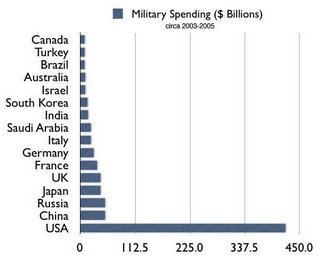
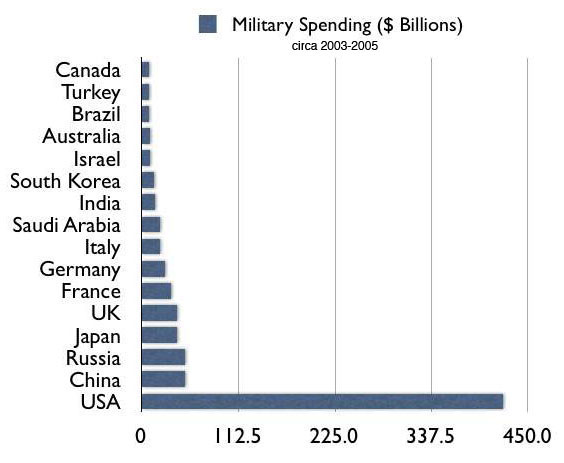
The United States government has the largest military budget in the world, and amounts to roughly 50% of all military spending worldwide. In 2006 the US military budget was $441 billion. It is worth noting that this does not include spending on the war on Iraq or Afghanistan, nor does it represent nuclear weapons research (part of the US Dept. of Energy budget). The following graph gives a nice summary of how US military spending compares to other countries, including its military "rivals" and members of the "Axis of Evil" (none of these grave threats made the list).
With the US national debt becoming more and more out of control and with lack of funding for education and other social services, responsible citizens should ask themselves whether all this military spending is justified or not. Is it really necessary for us to be able to win a war against the rest of the world, or would it be preferable if our leaders felt a little more compelled to resolve conflicts without resorting to the threat or use of force? Those in favor of this amount of spending might argue that we need a large military because we have taken on the honorable duty of protecting freedom, peace, and democracy around the world. Even without looking at history (which outright refutes this), it seems doubtful that the US government would spend its own money on safeguarding the well-being of foreigners when it doesn't even have the desire to provide health care to its citizens like almost every other country in the first world.
We're certainly seeing the problems associated with the military-industrial complex that President Eisenhower warned against back in 1961. Reducing the federal military budget by just a small amount could mean a huge boost to other social programs, such as education which comes in at only $88 billion.
On the other hand, let's for the sake of argument say that the US spending on defense is justified. Then we must ask ourselves whether we are getting the most bang for our buck. And I think we certainly are not. In 1997 the United Nations Human Development Report stated that the approximate cost of providing basic education, basic health and nutrition, reproductive health and family planning, water, and santitation for ALL in developing countries would only cost $40 billion/year for 10 years. Additionally, for an extra $40 billion/year, poverty could be eradicated completely. Imagine how popular the United States would be if we were to fund this! And this can be done all while maintaining a ridiculously high military budget in comparision to other countries. If the US really wanted to win the war against terrorism, then this would be a simple and sure way to do it. Terrorist organizations wouldn't be able to recruit if the US was seen as being so generous and benevolent towards others.
Unfortunately, I do not think this has a chance in hell of happening anytime soon. The reason that it won't happen is that the ruling interests in the country do not care about national security, nor do they care about peace in other countries. Military spending is a handout to the military contractors and as a tool to further US imperialistic interests abroad. If only Lockheed Martin made bread....
But probably the biggest reason against rising the standard of living in other countries would be the horrible hit on corporate profits. If you had access to food, water, education, and health care for you and your family, would you go to work in a factory for $1/day? Absolutely not. Only someone who is faced with the threat of death would consider throwing away their short life in this way.
I think this issue shows how important it is for American citizens to exert control on the government. The US is by far the most wealthy country in the world, and if allowed to, that wealth could transform the world into a much, much better place.
With the US national debt becoming more and more out of control and with lack of funding for education and other social services, responsible citizens should ask themselves whether all this military spending is justified or not. Is it really necessary for us to be able to win a war against the rest of the world, or would it be preferable if our leaders felt a little more compelled to resolve conflicts without resorting to the threat or use of force? Those in favor of this amount of spending might argue that we need a large military because we have taken on the honorable duty of protecting freedom, peace, and democracy around the world. Even without looking at history (which outright refutes this), it seems doubtful that the US government would spend its own money on safeguarding the well-being of foreigners when it doesn't even have the desire to provide health care to its citizens like almost every other country in the first world.
We're certainly seeing the problems associated with the military-industrial complex that President Eisenhower warned against back in 1961. Reducing the federal military budget by just a small amount could mean a huge boost to other social programs, such as education which comes in at only $88 billion.
On the other hand, let's for the sake of argument say that the US spending on defense is justified. Then we must ask ourselves whether we are getting the most bang for our buck. And I think we certainly are not. In 1997 the United Nations Human Development Report stated that the approximate cost of providing basic education, basic health and nutrition, reproductive health and family planning, water, and santitation for ALL in developing countries would only cost $40 billion/year for 10 years. Additionally, for an extra $40 billion/year, poverty could be eradicated completely. Imagine how popular the United States would be if we were to fund this! And this can be done all while maintaining a ridiculously high military budget in comparision to other countries. If the US really wanted to win the war against terrorism, then this would be a simple and sure way to do it. Terrorist organizations wouldn't be able to recruit if the US was seen as being so generous and benevolent towards others.
Unfortunately, I do not think this has a chance in hell of happening anytime soon. The reason that it won't happen is that the ruling interests in the country do not care about national security, nor do they care about peace in other countries. Military spending is a handout to the military contractors and as a tool to further US imperialistic interests abroad. If only Lockheed Martin made bread....
But probably the biggest reason against rising the standard of living in other countries would be the horrible hit on corporate profits. If you had access to food, water, education, and health care for you and your family, would you go to work in a factory for $1/day? Absolutely not. Only someone who is faced with the threat of death would consider throwing away their short life in this way.
I think this issue shows how important it is for American citizens to exert control on the government. The US is by far the most wealthy country in the world, and if allowed to, that wealth could transform the world into a much, much better place.
Wednesday, September 27, 2006
Quote of the Week
Political rights do not exist because they have been legally set down on a piece of paper, but only when they have become the ingrown habit of a people, and when any attempt to impair them will meet with the violent resistance of the populace
-Rudolf Rocker, Anarcho-Syndicalism
Wednesday, September 20, 2006
Capitalist "Libertarianism"
I was thinking a few days ago about the capitalist libertarian idea that people should be free to acquire as much power as possible in the economic sphere as they can get. They view the idea that society should be able to place some sort of restriction on this accumulation of power as a horrible threat to liberty and freedom. But that got me wondering, for what reason do they not also apply this logic to politics? Is it not a grave injustice for society to restrict someone from obtaining large amounts of personal political power for the same reason?
After all, are there many differences? Political power has to be preserved by force if threatened. But then so does economic power. Try having a monopoly on economic power without an army and police and see how long that lasts. Isn't competition going to assure that our political dictators are just as optimum as our economic dictators are? Some may object that a very ruthless person could become a political dictator, and this is different for the way that economic markets work. But what does the market reward more, a business who pays its employees well and doesn't pollute or one that ships its labor off to the 3rd world and dumps its pollutants in the water supply? Sounds pretty ruthless to me...
Anyway, just a thought. Perhaps this is all irrelevant since it's pretty obvious that economic power equals political power in this world, so arguing for arbitrarily high levels of either is really arguing for both.
After all, are there many differences? Political power has to be preserved by force if threatened. But then so does economic power. Try having a monopoly on economic power without an army and police and see how long that lasts. Isn't competition going to assure that our political dictators are just as optimum as our economic dictators are? Some may object that a very ruthless person could become a political dictator, and this is different for the way that economic markets work. But what does the market reward more, a business who pays its employees well and doesn't pollute or one that ships its labor off to the 3rd world and dumps its pollutants in the water supply? Sounds pretty ruthless to me...
Anyway, just a thought. Perhaps this is all irrelevant since it's pretty obvious that economic power equals political power in this world, so arguing for arbitrarily high levels of either is really arguing for both.
Wednesday, September 13, 2006
Quote of the Week
When I was a kid I used to pray every night for a new bicycle. Then I realised that the Lord doesn't work that way so I stole one and asked Him to forgive me
-Emo Philips
Tuesday, September 05, 2006
What have you been reading?
Yesterday Sportin' Life over at It Ain't Necessarily So tagged me for a book questionnaire thing that's been going around the blogosphere for the past week or so. So here we go.
One Book That Changed Your Life
I feel somewhat unoriginal for listing the same book as SL here, but I also think that Howard Zinn's A People's History of the United States was a book that really enriched my life. It wasn't that it made my outlook on life radically different, but simply that it helped me shape my ideas into a coherent and complete worldview. It also whet my appetite for the history of those like me, namely human beings, which seem all too neglected in traditional history lessons. For those unfamiliar with the book, I had a review of it this past May.
One Book That You Have Read More Than Once
With what I consider to be my political awakening happening only a year and half or so ago, I've been very busy in my spare time reading about new ideas and events and still have so many books on my plate that I couldn't imagine reading one of them twice. Now the first serious nonfiction book I ever read was Bertrand Russel's Why I Am Not a Christian. That was around the age of 15 or so, and I do remember reading select chapters of that book twice. The book meant a lot to me as I was reading it at a time when I didn't know anyone else who called themselves an atheist.
One Book You'd Want On A Desert Island
Obviously the most important book would be one that would help with survival, but this depends greatly on the exact nature of this desert island. For example, if there is only a mile or two of water between me and civilization, I might want a book on raft-making rather than a book telling me how to have safe sex with a cactus. So let's just assume that my basic needs are taken care of. Then I would have to say that by far I would want to have Peskin and Schroeder's An Introduction to Quantum Field Theory. This is because if I didn't read this book then I would be hopelessly behind the rest of the class when I returned to school.
A Book That Made You Excited
The book that probably got me worked up the most may have been Robert Reich's Reason: Why Liberals Will Win The Battle for America. I read this book at the beginning of my political awakening but perhaps a good few months before I left the mainstream. It was after I had voted for Bush's re-election. It's a good book, and exposes good progressive ideals alongside criticizing the goals and views of those he calls the Radcons. However, ultimately, the book is very much about outrage at the current situation and not about solutions. This is of course because the solutions, I believe, exist outside the range of mainstream options he's willing to consider. The solution is certainly not to play the political see-saw and elect Democrats into office.
One Book That You Wish Had Been Written
Tough question. I'd say either How the CNT/FAI won the Spanish Civil War and Changed the World or How I Lost My Leg in a Bear Attack by Paris Hilton.
One Book That Wracked You With Sobs
I've never actually cried while reading a book, although I am susceptible to emotional endings in movies. The last book that I had a somewhat strong emotional response to would be Rudolf Rocker's Anarcho-Syndicalism. While it's really a book of ideas, the clarity and style of the author's writing can trigger emotional responses in the reader, although the responses are more inspirational than sob-inducing.
One Book That You Wish Had Never Been Written
Oh I don't know, one of the big holy books? Although ignorance and a life devoid of meaning are much more the driving factors behind religion than a book is.
One Book That You're Currently Reading
While I haven't actually started it yet, the next book I will be reading will be Antony Beevor's The Battle for Spain: The Spanish Civil War 1936-1939.
One Book You've Been Meaning To Read
After finishing the book just mentioned, I also have sitting on my bookshelf the books A Homage To Catalonia by Orwell and The Spanish Anarchists: The Heroic Years 1868-1936 by Murray Bookchin. I've recently become very fascinated with the events leading up to and surrounding the Spanish Civil War.
Now Tag Five Bloggers
Five? It seems that everyone is cheating and isn't doing all five, so I won't either. I tag SH, Mookie, and breakerslion.
I feel somewhat unoriginal for listing the same book as SL here, but I also think that Howard Zinn's A People's History of the United States was a book that really enriched my life. It wasn't that it made my outlook on life radically different, but simply that it helped me shape my ideas into a coherent and complete worldview. It also whet my appetite for the history of those like me, namely human beings, which seem all too neglected in traditional history lessons. For those unfamiliar with the book, I had a review of it this past May.
With what I consider to be my political awakening happening only a year and half or so ago, I've been very busy in my spare time reading about new ideas and events and still have so many books on my plate that I couldn't imagine reading one of them twice. Now the first serious nonfiction book I ever read was Bertrand Russel's Why I Am Not a Christian. That was around the age of 15 or so, and I do remember reading select chapters of that book twice. The book meant a lot to me as I was reading it at a time when I didn't know anyone else who called themselves an atheist.
Obviously the most important book would be one that would help with survival, but this depends greatly on the exact nature of this desert island. For example, if there is only a mile or two of water between me and civilization, I might want a book on raft-making rather than a book telling me how to have safe sex with a cactus. So let's just assume that my basic needs are taken care of. Then I would have to say that by far I would want to have Peskin and Schroeder's An Introduction to Quantum Field Theory. This is because if I didn't read this book then I would be hopelessly behind the rest of the class when I returned to school.
The book that probably got me worked up the most may have been Robert Reich's Reason: Why Liberals Will Win The Battle for America. I read this book at the beginning of my political awakening but perhaps a good few months before I left the mainstream. It was after I had voted for Bush's re-election. It's a good book, and exposes good progressive ideals alongside criticizing the goals and views of those he calls the Radcons. However, ultimately, the book is very much about outrage at the current situation and not about solutions. This is of course because the solutions, I believe, exist outside the range of mainstream options he's willing to consider. The solution is certainly not to play the political see-saw and elect Democrats into office.
Tough question. I'd say either How the CNT/FAI won the Spanish Civil War and Changed the World or How I Lost My Leg in a Bear Attack by Paris Hilton.
I've never actually cried while reading a book, although I am susceptible to emotional endings in movies. The last book that I had a somewhat strong emotional response to would be Rudolf Rocker's Anarcho-Syndicalism. While it's really a book of ideas, the clarity and style of the author's writing can trigger emotional responses in the reader, although the responses are more inspirational than sob-inducing.
Oh I don't know, one of the big holy books? Although ignorance and a life devoid of meaning are much more the driving factors behind religion than a book is.
While I haven't actually started it yet, the next book I will be reading will be Antony Beevor's The Battle for Spain: The Spanish Civil War 1936-1939.
After finishing the book just mentioned, I also have sitting on my bookshelf the books A Homage To Catalonia by Orwell and The Spanish Anarchists: The Heroic Years 1868-1936 by Murray Bookchin. I've recently become very fascinated with the events leading up to and surrounding the Spanish Civil War.
Five? It seems that everyone is cheating and isn't doing all five, so I won't either. I tag SH, Mookie, and breakerslion.
Thursday, August 31, 2006
Reversing the Argument
Most open-minded people have thought about the possibility of alternatives to capitalism at one time or another. Unfortunately, I think many people quickly dismiss the idea because they think of one or two particular problems that could exist in an non-capitalistic society. The objections range from a number of things, but they generally start with, "It just seems like X would happen". I think many of the objections that people raise to non-capitalistic systems can be reasoned away with a better understanding of what the alternative is actually about as well as pulling from examples from historical events that are not taught and thus are not very well-known.
However, let's assume that they are valid objections. They certainly could be. After all, few would argue that the alternatives to capitalism are perfect, just that they are better. It's probably impossible to create *perfect* economic and political structures, and it's impossible to guarantee that a certain system will operate in ways that we desire, if only for the obvious reason that it's functioning hinges critically on the complex dynamics of society.
Having said that, imagine we reversed the situation. Imagine we were living in a socialist society and were theorizing about the possibility of changing to a capitalist society. Just think of all the criticisms one would have!
Wouldn't wealth begin to accumulate over time, resulting in the quality of lives that people have being determined almost 100% on the conditions in which they were born?
With wealth accumulating to such an extent, wouldn't those with wealth be able to undermine the democratic process, resulting in a loss of not only economic freedom, but also of political freedom?
Wait, so even though there are enough means to feed, clothe, and take care of the entire world population, millions will die from hunger and preventable diseases yearly because it is impossible to make a profit off of them? (I have some interesting data from a UN Development Report that I'll post on in the next few weeks relating to this).
Wouldn't those who owned the private resources and businesses be rewarded in the market for keeping wages low and polluting the environment?
Don't people work better when they "own" a part of what they work with rather than just be paid a wage to work for the benefit of someone else?
And so on....
Point being, when people think about alternatives to capitalism I hope that they will remember to think about what they are comparing it to.
However, let's assume that they are valid objections. They certainly could be. After all, few would argue that the alternatives to capitalism are perfect, just that they are better. It's probably impossible to create *perfect* economic and political structures, and it's impossible to guarantee that a certain system will operate in ways that we desire, if only for the obvious reason that it's functioning hinges critically on the complex dynamics of society.
Having said that, imagine we reversed the situation. Imagine we were living in a socialist society and were theorizing about the possibility of changing to a capitalist society. Just think of all the criticisms one would have!
Point being, when people think about alternatives to capitalism I hope that they will remember to think about what they are comparing it to.
Thursday, August 24, 2006
Busy Week
I've been wanting to post something for the past few days, but it's been very crazy for me as of late. The semester starts next week and I am basically in charge of the teaching of some 450 students, so I have a lot of preparation and organizational stuff to take care of. And for people whose blogs I normally read and post on, I'm sorry about my absence. I've read some good stuff but just haven't had time to give you my thoughts yet. Things should calm down a little next week.
Sunday, August 20, 2006
Bible Comedy
This is pretty funny. My favorite part is when he describes how the first man and woman were made.
Subscribe to:
Posts (Atom)
