Thursday, July 06, 2006

My Religious Deconversion Story

     This blog has been running for over a year now and I still haven't posted my deconversion story. What the hell is wrong with me? I figure I should remedy this now.

    I come from a family that I guess you would call Catholic. My father's parents are Baptist, but he's rather apathetic to religion, much more so now since my parents know that my brother and I are both atheists. So the religious aspect of our life was dominated by my mother, who had gone to a Catholic high school. Although she wasn't really dedicated to Catholicism, much more to just the general picture of Christianity, seeing as part of my early childhood we went to a Methodist church rather than the Catholic one we later went to, and then even later we went to one of those non-denominational, "worst concert you've ever been to" churches.

    My early church life was probably what's typical for most Christians. You go to Sunday School, learn about Noah's Ark and such, don't really believe it, but don't really think about the fact that you don't believe it. I really just didn't think about religion at all for the first 10 years of my life. I used to read the Sunday comics in church, which is a little odd because to this very day, I've never laughed at a comic in the comics section.

    My religious life changed when I was about 11 years old. I remember my mother was in my 9-year old brother's room trying to comfort him because he was crying about something. When my mom came into my room I asked what was wrong, and she said that he was worried about dying. Perhaps most 11-year olds wouldn't be affected, but in my youth I was a huge worrier. I worried about everything, especially about my health. I worried about cancer, leukemia, brain tumors, internal bleeding, brain damage, and even AIDs. From this and other behavior that I had as a youth I think I probably was obsessive-compulsive, although luckily I don't have the symptoms anymore at all (*saves post as draft 8 times for good luck*). Just kidding, but that would have been me before.

    Anyway, one of the ways that I stopped from worrying was to research what was bothering me and convincing myself that it was extremely unlikely that I had whatever problem I thought I might have. When I started worrying about death (eventual death, not immediate death due to some cause) my mother tried to comfort me by saying that I would be going to heaven when I died, in essence living forever. This is where my OCD (self-diagnosed, in retrospect) really kicked in for me. Now, in order to stop worrying about death, I felt that I should really explore this idea of heaven and be able to convince myself that I was indeed going, and that this place did actually exist. I wasn't going to simply take it "on faith" because like I said, I was a huge worrier. It had to be overwhelmingly clear that I didn't have a problem. So at this point I decided that I would more actively think about my religion, with the hope that I would soon convince myself of the near certainty of heaven, Jesus, God, etc. It didn't quite work out that way.

    I started to pay attention in church, which is probably the worst thing you can do if you want to keep your faith. The preacher would sometimes say something that was either racist, something against science, or some other absolutely ignorant statement. This bothered me, and I attempted to discuss it with my mom on the way home from church. They were legit criticisms, so she couldn't really defend them. She'd usually just say the typical "god works in mysterious ways" or "you just have to have faith" sort of garbage. The more and more I saw this excuse, the more I translated it to be "yes, you're correct, our pastor is psychotic, and that part of the bible doesn't make sense at all". So after only a few months of this increased attention in church, I began to seriously doubt the competence of the preacher, and I was probably also a little angered by some of his statements. This was convenient because it put me, at least in my head, opposed to him. And when you're opposed to someone, you usually put in a lot more critical thinking into trying to debunk what they say. I should say that by this time I probably had moved on from worrying about death and was probably worried about some skin-eating disease or something instead, but now I was focused more on religion.

    So being opposed to the preacher, I would listen to him talk and actually think critically about it. And so you can probably imagine how easily I began to doubt the most blatantly stupid of the stories in the bible, like the one of Jesus cursing at a fig tree for example. After enough of these examples, I just decided that organized religion was completely wrong. I didn't really believe anything that the Bible contained, although I held on to the vague idea of Jesus dying for our sins and the existence and nature of God. I probably held this general state of belief for a few years, until the age of about 14. I don't remember what prompted it, but I began to think about these issues again. I thought about the necessity of Jesus coming down to save people. My thinking was as follows

  • Jesus came to forgive us of our sins, and allow us to go to heaven. God sent him to die on a cross.
  • God controls whether we go to heaven or not; nothing is outside of his power. God could allow us to go to heaven unilaterally if he wanted.
  • God sent Jesus down to die so that he could tell himself to let us into heaven. God is a moron, and so doesn't exist.

    The night I thought this, I said to myself "omg, I'm an atheist". Instantly, the connotation of "devil-worshipper" and feelings of having done something wrong came to mind, because that's what I had learned to associate with the word atheist. I realized that these feelings and associations were completely unjustified, and this made me doubt religion even more for having made me think otherwise.

         So that's pretty much the entire story. While my atheist position has surely become more sophisticated with time, reading of books, and reading of all the great blogs in the atheist online community, my actual deconversion was complete.
  • Monday, July 03, 2006

    Happy 4th of July

         Today we celebrate our independence from Great Britain. Why did we want independence? One popular cry was "no taxation without representation". Over two hundred years later, how are we doing in this category? We do have formal representation at least. But do our politicians actually represent us? Or do they simply represent a small sector of society and then lie to, ignore, or simply distract the others with "threats" to our freedom coming from indians, blacks, japanese-americans, communists, terrorists, gays, liberals, secularists, and mexicans?

        Another reason for wanting independence was so that we wouldn't simply be a exploited source of resources and so that we could have our own autonomous political system. Economic and political independence was our goal. But if you look at the situation today our government vigorously opposes economic and political independence for other countries, and has done very well in succeeding in these aims in the past, even if that involves putting in power brutal dictators that massacre their own people.

        Point being, I just don't see much reason to celebrate the 4th of July (other than those incredibly entertaining Snake fireworks). It would be like celebrating the unchaining of a dangerous animal into a crowded room. I believe it's very important for us to finally make real progress on the above two issues of economic and political freedom, both domestic and foreign. We don't have to demand freedom for ourselves, but we have a moral obligation to control our political situation to the extent that it doesn't interfere with the freedom of others.

        Have a good 4th everyone.

    In addition, here is a short 4th of July article by Howard Zinn.

    Friday, June 30, 2006

    MUST SEE: The Revolution Will Not Be Televised

         Wow, I just got done watching the documentary The Revolution Will Not Be Televised which covers the events surrounding the coup which put Venezuelan President Hugo Chavez out of power temporarily in 2002. It was filmed by a group of Irish filmmakers who were doing a documentary on Chavez but then got caught up in all of the action as it took place. Maybe I'm biased towards films like this, but I thought it was fucking amazing. I've never been so interested in what was going on in a documentary before.

         Quit wasting your time reading this and go watch it over at Google video. Below are the parts that I liked the most. Don't read the following if you're going to go watch it, it might spoil some of it for you.

  • At the beginning of the movie, before the coup, the filmers were at a meeting on the wealthy side of town where a bunch of rich, white people were gathered and discussing what they should do. A rich, white girl tells the filmers that the poor have no values and that they haven't "struggled" like the rich have. But then, when they are filming the meeting that she is attending, the speaker at the meeting says "keep an eye on your domestic servants". I thought that was great. Having domestic servants can really make life tough.

  • The film shows clips of the private media during the whole ordeal and of course the media shows a very obvious bias and even lies when the people retake the Presidential palace after the coup. Before the coup however, when covering the peaceful demonstrations in support of Chavez, the media says that the demonstrators were "like the mobs used by Mussolini and Hitler".

  • There was awesome footage shot in the Presidential Palace of the guards and people when they knew that the army had switched sides and was surrounding them with tanks and was planning on bombing the building if Chavez didn't resign as President.

  • When the people took back the Presidential Palace, the Chavez's VP was getting sworn in as President (Chavez was being detained by the army). After being sworn in, you see the VP on the phone saying to someone "I hope this will settle now that I've been sworn in as Vice President", and then you hear someone else say "You're President" and then he says "Yes, I mean President". I thought that was amusing.

  • I think the most exciting part of the film is when the people in support of Chavez surround the Presidential Palace currently being controlled by the "transitional government". With the people around it, the guards of the palace (with hidden loyalties to Chavez) decide to organize and take back the building. Once they've taken it back, you see a couple of soldiers on top of the building with their fist in the air and waving at the cheering people.

         I meant to make a post about my religious deconversion today, but that will have to wait until next time. I just had to tell you about this documentary. Hope you like it.
  • Monday, June 26, 2006

    Vote Green: Bad Behavior Bumper Sticker

         This weekend I was waiting on my fiancee in a mall in Portland and I started to think about voting. I used to be very gung-ho about voting. This isn't really much of a surprise since I was also a Fox News watching, Bush voting, hard-core, jingoistic patriot. However, since my political deconversion (which I view as being, at least in practical matters, more important than my religious deconversion) I now look at voting much differently.

        As I've mentioned in a previous post, I think the two-party system is absolutely horrible, a complete joke of a democratic system. As Hellen Keller once said

    Our democracy is but a name. We vote. What does that mean? It means that we choose between two bodies of real -- though not avowed -- autocrats. We choose between 'Tweedledum' and 'Tweedledee'


    showing that even being blind and deaf is not an excuse for believing in the 2P system.

        But anyway, it's what we've got, and until we can change it, how should we act within it? One suggestion is that we vote Democrat. Why would I want to do such a thing? The Democrats don't even have the moral clarity to be able to denounce the Republicans strongly for what they're doing. Senator Biden quickly retreats from any suggestion that Bush should be impeached, and simply stops at censure. And I choose Biden because he seems to be one of the better Democrats. Most Democrats wouldn't even speak favorably of Biden's censure resolution. I'm sorry, but if you can't even say with confidence that Bush should be censured, then there is no way in hell that you deserve my vote. And in many respects, Democrats are very much like Republicans. Most Democrats are also just as much in the hands of big business as the Republicans are. Democrats have started wars of aggression against innocent people in the past also; Iraq wasn't an Republican invention (which is another thing that Democrats won't denounce strongly enough to make an impression on the American people). The Democrats do differ from the Republicans in their rhetoric however, but less so recently, and with the Democrats looking at stealing some of the evangelical vote in the upcoming elections you'll probably see more references to God in their speeches as well.

        Some suggest that voting is completely worthless and even harmful. They say it gives legitimacy to a corrupt system, which I think is hard to refute. It's the worthless attribute that I'm skeptical of, and I'll address that next. From those who want a completely different system, whether it being a different economic or political system, the claim is that this can't occur by participating in the current system, but that one must overthrow the current system by other means. I think that they are generally correct in this view, but I don't think that the solution is to not participate. Look around. Revolution is not around the corner. Republicans are getting elected. I don't want to be in a revolution of people who vote Republican and defend torture on primetime TV. I think it makes sense to try to shift the political debate to the left first, and then, perhaps when people are more sympathetic to concerns relating economic fairness, sustainability, democracy, freedom, and peace, well then perhaps then we'll have a revolution and overthrow the corrupt systems that control our lives and endanger humanity.

        I think the best thing that we can do is vote third party, such as the Greens. For one the Green positions are often close to my own and so it's nice to actually be able to vote for a candidate that represents my views in at least a rough sense. Voting Green shifts the political debate to the left, because it forces the Democrats to look to the left for votes. Without this incentive, the Democrats will simply go over to the right, which is where all the money and all the unquestioning voters are (thanks Jesus). And perhaps if enough people vote third party, we'll be able to start a movement toward a proportional representation (PR) system.

        With this reasoning I've decided to become more active with the Green party. Will much good come out of it? I'm doubtful, but I'm not ready to completely give up on voting yet. During my wait at the mall I decided to create a bumper sticker for my car, as seen below.


        If anyone is interested in purchasing one, you can buy them here. And if you haven't checked out Cafepress before, you should. They have a lot of really nice designs, for t-shirts, bumper stickers, coffee mugs, etc.

    Thursday, June 22, 2006

    Random Comedy

         I'm going to be out of town for the next few days. In the meantime, check out the Farting Preacher .

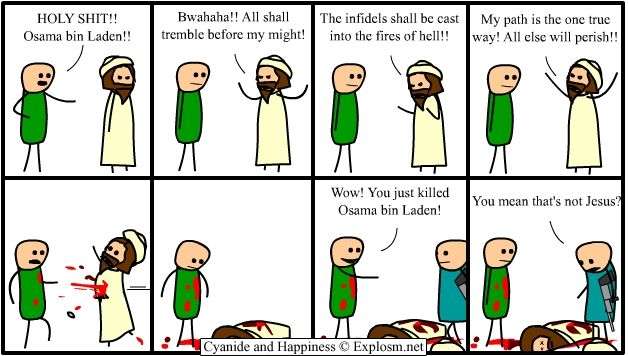
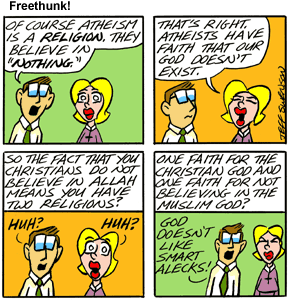
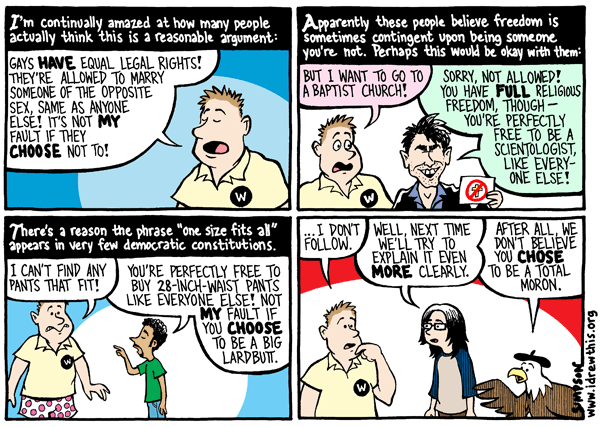
    In addition, here's a few really good cartoons (stolen in the worst possible way from beepbeepitsme and Atheist Girl)


    Also, for you fans of Paperboy on NES, you MUST check this out (h/t to Wustlog).

    Sunday, June 18, 2006

    Parecon Reading #1


         This weekend I got busy with my goal that I mentioned in my last post of learning more about Parecon. I ordered Parecon: Life After Capitalism by Michael Albert and read my first non-Wiki article on the subject. This was an introductory paper by Michael Albert and Robin Hahnel entitled Socialism As It Was Always Meant to Be. It's not too long, but it gives I think a good introduction to the basic concepts of participatory economics.

         I'm not going to write a book report type of summary here, because that's incredibly inefficient when you could just read it yourself. Rather, in the spirit of learning together and discussing, I'll mention a few aspects of the article that I found interesting.

         Firstly, the notion of rewarding people based on their effort, i.e. "to each according to his or her labor". This was a feature that I knew existed in Parecon before reading this article and I had some definite skepticism about this. Shouldn't those who are naturally gifted and intelligent benefit the same from less effort if they can produce more efficiently? I'm not criticizing Parecon in that there wouldn't be incentives for innovation, because I think they made a decent case in such a short paper that there would indeed be. However, this idea is relatively new to me. They argue that giving people more just because of their gifts that they are born with is no different than giving people more because they are born with more money and property. And I can see this point of view. However I don't think that analogy works completely because intellectual differences contribute to real differences in productivity, whereas property ownership simply means that you're benefiting from someone else's productivity. However, even this sort of compensation might result in an increase of living standards for educated people over what they get in the current capitalistic system. In the current economy, when you think of the big money, who do you think of? CEOs and property owners get the lion's share of the economic output, yet produce little to nothing of value. Jobs that take a lot of education, like science for example, get paid next to nothing in comparison.

         I also thought the idea of Workers' and Consumers' Councils and the iterative planning process that they are involved in was interesting. They didn't discuss this too much in this paper, and I look forward to hearing more about the details of it in upcoming readings.

         What were your thoughts? Does anyone else want to host the next reading or next topic? It doesn't have to necessarily contain a reading.

    Thursday, June 15, 2006

    Miscellaneous

        Here's a bunch of different things I wanted to say, most of which don't justify their own post. So here we go.

  • Thanks to Foosh from Wustlog for bringing Google Analytics to my attention. It can give you some pretty cool information about the visitors who come to your site. You have to request to be invited, but I was accepted just 2 or 3 days later.

  • For those of you who might have wondered how the YearlyKos meeting in Las Vegas went, LBBP from Skeptic Rant has a first-hand account here. Also, I've heard that the GOP is going to use euthanasia as one of its focuses for the 2006 elections. And I'm glad. This affects me so much more than war or the economy. And it's about damn time I lost the right to end my own life. Only our Leader can make decisions that end lives. Anyhow, Fair Enough has a post about the issue here.

  • I just watched Ann Coulter on Jay Leno tonight, hoping that something interesting would be said by Carlin, who was also on the show. He didn't say anything of interest. But I got a little pissed watching it. For one Coulter is a fucking psycho. And actually listening to her talk made me realize that she's even more of a pyscho than I had previously thought, which is hard to do. But I basically knew that beforehand. What bothered me was the applause that she received after she would state her disgusting and pathetic point of views. She got booed a little, but the applause was much louder. It was just sickening.

  • In the comments of my last post there was some discussion about alternative economic systems, namely Parecon (Participatory Economics). Personally I don't know that much about Parecon, and from the little reading I've done of it there are some issues that I don't agree with. However, Parecon has also gotten some good reviews from people whose opinions I respect, and I feel that it would be beneficial to look into the issue more. Most notable of these is Chomsky, who says of Parecon
    A great many activists and concerned people ask, quite rightly, what alternative form of social organization can be imagined that might overcome the grave flaws -- often real crimes -- of contemporary society in more far-reaching ways than short-term reform. Parecon is the most serious effort I know to provide a very detailed possible answer to some of these questions, crucial ones, based on serious thought and careful analysis


         Even if its not perfect (which is certain), it may easily be superior to capitalism and worthy of progress towards. And the flaws it does have, well, by learning about them perhaps we could improve on the ideas.

        Anyhow, I plan on learning about Parecon in my free time for at least the rest of the summer. What I thought would be nice is if others wanted to learn more about this as well, defend it, or simply critique it, we could structure our discussions in a "reading course" type of way. I basically imagine selecting an article or paper discussing the concepts of Parecon, of which there are many available (especially on Znet), and then someone would write up their opinion on the particular concept of Parecon that the article was about and people would discuss it. A week later (the exact time depending on how many participants we had) it would be someone else's turn.

        Would anyone be interested in this?
  • Thursday, June 08, 2006

    Book Review: Government in the Future by Noam Chomsky


         Noam Chomsky's Government in the Future is a small book based on a talk that he gave in New York in 1970 in which he asks "What is the role of the state in an advanced society?" To answer this, he gives his views on four major political positions-classical liberalism (libertarianism), libertarian socialist, state socialist, and state capitalist.

        He makes his personal preference known from the outset. He states that he believes
    libertarian socialist concepts (left-wing Marxism through anarchism) are funamentally correct and are the proper and natural extensions of classical liberalism into the current era of advanced industrial society


    He then begins his look at classical liberalism. He says
    Classical liberalism asserts as its major idea an opposition to all but the most restricted and minimal forms of state intervention in personal in social life. This conclusion is quite familiar. However, the reasoning that leads to it is less familiar and I think a good deal more important than the conclusion itself


    This reasoning for limited state intervention, Chomsky explains, was that man's most important attribute is his freedom. Citing the 18th century libertarian Alexander von Humboldt,
    To inquire and to create-these are the centers around which all human pursuits more or less directly revolve.......Whatever does not spring from a man's free choice, or is only the result of instruction and guidance, does not enter into his very being, but remains alien to his true nature; he does not perform it with truly human energies, but merely with mechanical exactness


    Chomsky then compares Humboldt's statements with those of Karl Marx, born a half a century later, who speaks of
    the alienation of labor when work is external to the worker, ...not part of his nature,....[so that] he does not fulfill himself in his work but denies himself...[and is] physically exhausted and mentally debased


    Chomsky continues

    Robert Tucker, for one, has rightly emphasized that Marx sees the revolutionary more as the frustrated producer than as a dissatisfied consumer. And this far more radical critique of capitalist relations of production flows directly, often in the same words, from the libertarian thought of the Englightenment. For this reason, I think, one must say that classical liberal ideas in their essence, though not in the way they developed, are profoundly anticapitalist. The essence of these ideas must be destroyed for them to serve as an ideology of modern industrial capitalism.
    Writing in the 1780s and early 1790s, Humboldt had no conception of the forms that industrial capitalism would take. Consequently, in this classic of classical liberalism he stresses the problem of limiting state power, and he is not overly concerned with the dangers of private power. The reason is that he believes in, and speaks of, the essential equality of conditions of private citizens. And of course he had no idea, writing in 1790, of the ways in which the notion of a private person would come to be reinterpreted in the era of corporate capitalism. He did not foresee-I now quote the anarchist historian Rudolf Rocker-that "Democracy with its motto of 'equality of all citizens before the law,' and Liberalism with its 'right of man over his own person,' both [would be] shipwrecked on the realities of the capitalist economic forum." Humboldt did not foresee that in a predatory capitalistic economy, state intervention would be an absolute necessity to preserve human existence and prevent the destruction of the physical environment....Humboldt also did not foresee the consequences of the commodity character of labor,the doctrine,again in Polanyi's words, that "it is not for the commodity to decide where it should be offered for sale, to what purpose it should be used, at what price it should be allowed to change hands, and in what manner it should be consumed or destroyed." But the commodity is, of course, in this case, human life....


    I'll stop there for the reasons of length, but Chomsky continues in much the same way for two more pages, until he reaches the concluding statement
    Classical libertarian thought seems to me, therefore, to lead directly to libertarian socialism, or anarchism if you like, when combined with an understanding of industrial capitalism


         He then begins his discussion of libertarian socialism. This collection of ideas
    reflects the intuitive understanding that democracy is largely a sham when the industrial system is controlled by any form of autocratic elite


    Chomsky then goes on to explain some of the basic thinking associated with libertarian socialism and discusses some events in history related to the ideas or those who held them. I won't go into those ideas here, partly for length and partly because I will have another book review in the next month on a book that deals primarily with these concepts. He then addresses two counterarguments against this sort of social system, those being that such an organization is contrary to human nature, and that it is incompatible with the demands of efficiency.

         Chomsky ends the book by looking at state capitalism and state socialism. But rather than discuss these ideas abstractly, he looks at the behavior of the United States and the Soviet Union. In 1970 when he gave this talk it was surely a good way to discuss these issues, but I didn't find this small section particularly illuminating, perhaps because I've heard Chomsky and others discuss these issues in much greater detail than is allowed in a public talk.

        In conclusion, I thought it was a good read. I had gone into the reading thinking that he might make predictions about the government in the future, but instead he simply discussed some major political philosophies. However, in hindsight, this is the logical thing for him to do. The government of the future is for us to decide, and the first step towards a decision is to hear about all the options.

        I wouldn't recommend buying the book though. It's only 67 pages long and there isn't even that many words per page (like I said, it's a speech). Get it at the library if you can and read it, it won't take more than an hour. Also, you can listen to an audio version of the speech at the last link on the page here. In my opinion it's somewhat hard to listen to the talk because Chomsky intermingles a lot of quotes of people in his talk and without the ability to see it separated as you do in a book, or see Chomsky reading from his notes (as you would in a talk), it can be hard to distinguish when he's talking and when he's quoting someone.

    Sunday, June 04, 2006

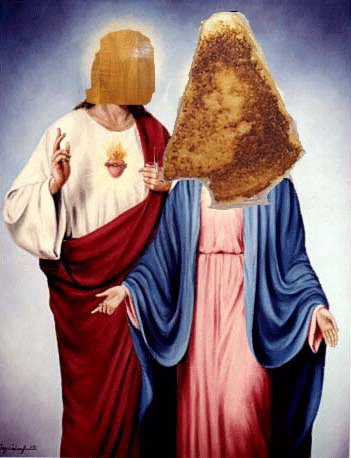
    Grilled Cheese Virgin Mary Continues to Inspire


         This is a followup to my earlier Virgin Mary grilled cheese related story here. Apparently the lady is getting it tattooed to her chest (video here) She explains herself with "We all believe in certain things okay, and this is what I believe in, and this is what I want close to my heart". It's never felt so good to not be included in her We.

         And another thing, for something she loves so dearly it seems odd that she would simply sell it. Well, I suppose she probably consulted with her Savior first and he told her that it was okay. Too bad he didn't tell her to spend that extra dough on some new front teeth though. Bah, what am I thinking, teeth look trashy.

    Thursday, June 01, 2006

    MoveOn Vote Decides on Focus for 2006

        Last week MoveOn coordinated house parties around the country to brainstorm on what issues they could get their members to rally around and support. This week members were emailed and given a chance to vote and decide which 3 out of the 10 listed issues would become the primary focus for MoveOn in 2006. I signed a petition against the genocide in Darfur and ended up being a "member" so I was able to participate. I certainly don't consider myself a Democrat, but MoveOn works for some good causes and I'm glad to help make any difference that I can.

    So first, the ten issues that were voted on:

  • A balanced federal budget
  • Publicly funded elections
  • A guaranteed living wage
  • Solutions to global warming
  • High quality education for all
  • Global leadership through diplomacy
  • Guaranteed accurate elections
  • Restored constitutional rights
  • Sustainable energy independence
  • Health care for all


  •     I was really hoping that publicly funded elections would win out. This is because if you can get the politicans responsive to the people, which is something we haven't tried in this country before, many of the other reforms would be much easier to achieve. And I was really hoping that "global leadership" and "restored constitutional rights" would lose. That's beause I didn't think these issues were concrete and there's no way you could measure progress. What would you do, ask politicians to promise to honor your constitutional rights? What Bush is doing now is flagrantly illegal, but most politicians say that it's legit or at best that it should be "looked at". Without real politicians in office or without a great deal of public outrage and activism, criminal behavior will never be punished. The same sort of deal with global leadership. Most politicians would tell you we're the global leader now.

        The winners of the poll were sustainable energy dependence, health care for all, and a tie (very close in votes) between restored constitutional rights and guaranteed accurate elections, which they're combining into a single title of "restoring democracy". I think both of the first two are good concrete goals that would be nice if they could achieve. "Restoring democracy" isn't really a concrete goal in the same sense that the others are. But if MoveOn is prepared to use its resources to make a change in the minds of the American people, and get them to realize what democracy is and why it's important, then perhaps this issue could be a good thing as well. I think all these issues would be achieved much easier and much less superficially if progress could be made with campaign finance reform, but perhaps this goal isn't feasible at this time. It'd be pretty easy to produce propaganda against it, along the lines of "George Bush wants YOU to pay for his election party". So maybe we're not ready for that.

        Energy independence is going to be the first issue that they tackle, starting this month, and I'll probably have a post on it later. If you'd like to be get emails from MoveOn just sign up.

        Which issues would you or did you vote for?

    Monday, May 29, 2006

    Just Click on It to Make it Bigger


    In addition, you should check this christian video game out. Story on it here and the Left Behind Games' website here. The news report on the Left Behind website asks "Is violence in the name of god any better than just plain violence?". Uhmm...I'm going to jump in on this and say holy shit no, it's much, much worse.

    And as a reminder, for those of you that get MoveOn.org emails, go vote in the poll to determine the organization's focus for 2006. You can vote until Wednesday at midnight. I'll have a post about the outcome on Thursday.

    Tuesday, May 23, 2006

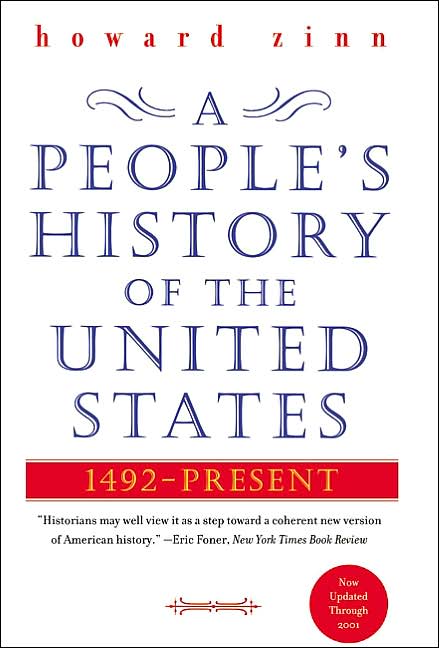
    Book Review: A People's History of the United States by Howard Zinn

         The philosopher George Santayana once wrote "Those who cannot remember the past are condemned to repeat it". Implicit in this statement is that knowledge of history can help us better understand the present and assist us in making good decisions. But as I think of my history education growing up, especially those classes before college, I don't see any aspects of that education which would help me better understand the world today. Let's see, if I become a fascist German dictator I won't attack Russia (at least not in the winter). I also guess I won't settle political arguments with a duel. And if I'm ever a Native American I sure as hell ain't going to trust Whitey. Yes, this information is definitely going to be useful to me.

         Traditional history education leaves one completely unprepared as to how to put into context the political situation in the country today. Reading traditional history gives the impression of a country unified with people of common interests. Internal conflict in minimized or ignored altogether, while conflict with foreigners is given emphasis, helping to instill in American youth a sense of deep patriotism and suspicion of others who happened to be born on dirt that fell inside a different countries invisible borders. Today's conflicts in politics, in war, and in economics seem to be unique if traditional history is all we know. Yet there is much in history that sheds a great deal of light onto these subjects and then one can see the truth behind Santayana's statment.

         Howard Zinn's book A People's History of the United States is a great starting point for this. While traditional histories tell history from the point of view of statesmen or from the wealthy, Zinn tells "America's story from the point of view of-and in the words of-America's women, factory workers, African Americans, Native Americans, working poor, and immigrant laborers". In other words, from the point of view of the average person.


         I finished this fairly long book (700 pages) about 30 minutes ago and I really enjoyed it. I also learned a lot. It starts from the landing of Columbus in 1492 and goes up until the invasion of Afghanistan. I was horrified at exactly how unbelievably cruel the Native Americans were treated. This treatment they faced is many orders of magnitude worse than the impression that I had from high school. I also found it interesting to read about all the class conflict between workers and employers and how often and how unified workers were in their strikes, often during times when the rest of the country was suffering from extreme racism. And it angered me each time as the police, national guard, or army would come in on the side of the owners and break up the strikes, many times shooting workers or forcing them to work against their will. I found it extremely interesting to know how widespread socialism and socialist thought was in the United States, especially before the Espionage Act during WWI landed many prominent socialists in jail for free speech "violations" and of course before the McCarthyism of the 1950s made it illegal to not love capitalism. I learned a lot of details about Vietnam that I hadn't heard before and was glad to have a better understanding of this major part of American history.

         As I read this book I noticed time and again history repeating itself in ways that are helpful to understand today. From the government lying or omitting important information to bring the country to war to the way that the government sets up "investigations" of itself in order to make the public think that it's reforming after some scandal when in actuality the system isn't changing at all, I saw trends that went throughout history and continue in the most blatant way today. Instead of the usual "Paul Revere liked to ride horsies" historical trivia, the book actually contains the type of lessons that increase one's understanding of today's world.

         I highly recommend this book. You can buy it here. And also, on an unrelated note, I just finished up a very busy few weeks and so posts should be more frequent. Thanks for your patience!


    Friday, May 12, 2006

    Support Net Neutrality

         I've been really busy lately and haven't been reading any of the emails that MoveOn.org has been sending me. But today I looked at one and got a little educated on this Net Neutrality issue. Here's a brief explanation from the FAQ at Save the Internet.


    What is this about?>

    This is about Internet freedom. "Network Neutrality" -- the First Amendment of the Internet -- ensures that the public can view the smallest blog just as easily as the largest corporate Web site by preventing Internet companies like AT&T from rigging the playing field for only the highest-paying sites.

    But Internet providers like AT&T, Verizon and Comcast are spending millions of dollars lobbying Congress to gut Net Neutrality. If Congress doesn't take action now to implement meaningful network neutrality provisions, the future of the Internet is at risk.

    What is network neutrality?

    Network Neutrality — or "Net Neutrality" for short — is the guiding principle that preserves the free and open Internet.

    Net Neutrality ensures that all users can access the content or run the applications and devices of their choice. With Net Neutrality, the network's only job is to move data — not choose which data to privilege with higher quality service.

    Net Neutrality is the reason why the Internet has driven economic innovation, democratic participation, and free speech online. It's why the Internet has become an unrivaled environment for open communications, civic involvement and free speech.

    Who wants to get rid of Net Neutrality?

    The nation's largest telephone and cable companies — including AT&T, Verizon, Comcast and Time Warner — want to be Internet gatekeepers, deciding which Web sites go fast or slow and which won't load at all.

    They want to tax content providers to guarantee speedy delivery of their data. They want to discriminate in favor of their own search engines, Internet phone services, and streaming video — while slowing down or blocking their competitors.

    These companies have a new vision for the Internet. Instead of an even playing field, they want to reserve express lanes for their own content and services — or those from big corporations that can afford the steep tolls — and leave the rest of us on a winding dirt road.


         Also, there's 5 videos here, including an explanation from a ninja, a Halo character, and more. I had no idea what the ninja was talking about. The last few videos are probably the best in terms of information.

        I think this is a very dangerous situation. An absolutely free internet is crucial for all that is rational, fair, and democratic. It is the only means by which people can communicate to large numbers of other people and avoid the mainstream media which spouts nothing but propaganda. If we lose the internet, we lose our voice, and with it, our hope.

        So get involved. Or at least educated yourself. Without knowing what it's about, you might fall victim to a video like this which gives a very inaccurate representation of the situation.

    Update Actually, the ninja makes a very compelling argument. I recommend that one.

    Sunday, April 30, 2006

    MUST SEE VIDEO

         Yesterday Stephen Colbert, host of the TV show The Colbert Report on Comedy Central, hosted the White House Correspondents Dinner. Almost everyone was there: the president, first lady, the outgoing and incoming press secretary, Scalia, everyone, well, except for Cheney. Anyhow, Colbert was outrageously candid and hard hitting in his jokes. So much that watching the video you can see and really feel the awkwardness (since most of the people he was making fun of were in the room). The highest quality version of this video is here (there's two parts~15 min). If this is laggy, try YouTube.

         I have so much respect for Colbert after doing this. It's one thing to speak truth to power, but another to do it with them sitting a few seats away from you. Colbert could have just done a few lighthearted jokes. This is what almost anyone else would have done. But no, he used this opportunity to really make a statement. If you read about the story in the corporate media they'll really shift the focus off of Colbert and onto some stupid Bush look-alike, but after you watch this video you'll see that this is really the interesting story. So watch this and pass it along to your friends, otherwise they won't hear about it. And please don't pity Bush while watching this, he deserves much more than public humiliation.

    Update- If you'd like to thank Stephen, there is now a site up so that you can do so. As of this posting 36,000 people have posted a thank you!

    Friday, April 28, 2006

    Free Market Fantasies

        It seems that any discussion of politics ends up involving some sort of debate about economic systems. Since most atheists tend to identify themselves as liberal or libertarian, I thought that it'd be interesting to address these perspectives. I disagree with the liberal point of view because I believe that governments, much less powerful ones, can be very dangerous to people's freedoms. I also do not personally like the idea that someone who refuses to work will enjoy the fruits of labor of those who do. However, in this post I want to talk about the libertarian point of view. This is because while the liberal point of view is something that I don't personally like, the libertarian point of view is generally based upon the idea of a "free market", and this idea is one which I think is a complete fantasy.

         So first off, I'd like to say to those that think a free market is the best way to run an economy that I don't necessarily disagree with you. You may be right. I haven't put too much thought into it, and the reason for this that I don't think free markets can exist in actuality, and so talking about how nice it would be is a waste of time. Additionally, slight deviations from a truly free market result in a situation which I think is hard to argue for since essentially all of the redeeming characteristics of a free market are lost.

        The good thing about a free market economy is that products that are the best value succeed. If someone is charging too high of a price, someone else can come in and sell lower and still make a profit. The competition drives prices down and productivity up. However, this is not how markets work. When someone succeeds in business, they don't go back to square one. They're more wealthy now. This gives them an advantage which they can exploit to make their products, even if vastly inferior, succeed. If I'm wealthy I can simply drive my competitors out of business by operating at a loss, since I can sustain that while newcomers can't. Moreover, I have the money to advertise while others do not, and people might buy my inferior quality products for a higher price. This and other factors lead to the result that it's not the best quality products that succeed, but generally those who have previous wealth who succeed. Their previous success gives them current success, which gives them future success, and so on. Because the "game of capitalism" doesn't start anew, it overwhelmingly favors those whose are already wealthy. While some may or may not have a problem with this, the point is that this advantage destroys the level playing field and makes the market less competitive and thus not free.


        Another criticism of a free market is the existence of externalities, which create costs to the consumer that are not reflected in the purchase price. Pollution is a good example of this. A company which has the lowest costs can sell for lower, thereby giving their product an advantage in the marketplace. They can lower costs by mishandling the pollutants that product production creates. The market rewards this sort of behavior with a competitive edge, yet the actual price of their products is much higher than those of a competitor who doesn't pollute. Now it's true that you could hold people responsible for learning about the companies they buy products from. While this would be very difficult to do, I'm not entirely against this argument, although I think it's doubtful that people would be able to adequately judge what the businesses were up to.

        So to me, a free market is to economists what a massless string is to physicists. It's a nice idealization to help teach people basic concepts, but please don't build anything with it.

    Saturday, April 22, 2006

    How hopeful are you for the future?

        I've had a lot of trouble blogging the past few weeks, and besides my busy schedule, I think the big reason is that I just don't feel that the situation in the world and in the U.S. is going to get better in both the near and distant future and it really sucks the motivation out of me.

         I hear a lot of people talking about how things are going to change after the 2006 midterm elections, but I really don't think it's going to make a difference. The Republicans might lose a few seats, but that's probably it. And in my opinion, it wouldn't even make a difference if the Democrats won a ton of seats. The Democrats don't even have the moral and intellectual clarity to call out the Republicans on all the crazy ass shit they do. Think it's because the dems don't have a backbone? On the contrary, I think they do, it's just that they really don't differ too much from the Republicans on these issues. Both are pro-business, pro-war parties who are in the hands of the wealthy. Sometimes you hear rumors that the Democrats are for giving gays the right to marry, funding stem cell research, and pulling the troops out of Iraq. But these are usually just quiet murmurs, and few Democrats take an actual strong stand that would be necessary to infuse enthusiasm into the issue. Not supporting scientific advances and equal rights for people of different sexual preferences SHOULD make it utterly impossible to get elected in a free, democratic society. And lying to the public to start a war of aggression is a war crime by the Geneva conventions. However, the current administration and mainstream media have made war crimes "patriotic" and dissent "treason". In a poll conducted in March, only 38% of the American public thought that the President should be censured for war crimes, much less impeached. Hell, this guy's approval ratings are still in the 30s! It would be utterly impossible for the remaining people to disapprove of him it seems, and these people are a large enough group that they themselves can almost get someone elected.

         If the Democrats take back a lot of seats this year, what will we get to look forward to? Well, maybe they'll start the process on stem cell research and gay marriage. After a few years perhaps we'll have those things. Big deal, we'll still be sprinting toward disaster because of our utter disregard for any issue that's important to our civilization's survival. And even if they allow gay marriage, I'm going to have to wait forever until the slippery slope allows me to marry that deer in the woods I've always had the hots for.

        So I'm curious, how hopeful are you for the future?

    Sunday, April 09, 2006

    At Best, Prayer Doesn't Work

         The blogging has been pretty light lately. Sometimes I wish I didn't imply a certain timescale for posts in my blog title. Maybe Freethought Sporadically would be more appropriate. Anyway, I have an interesting video clip you will probably like. Some of you may have heard of the study done on heart patients where some were prayed for, some weren't, etc, in order to see if prayer affected anything. Turns out that those who were prayed for had a slightly higher risk of complications, but other than that of course nothing was different. Jon Stewart recently covered this in a funny segment on the Daily Show. Just go here and click on the video "Votive or Die". LBBP has a funny post about this as well.

    Monday, March 27, 2006

    Virgin Mary Tags Another Bridge

    Last night I caught part of the local news and I'm glad I did. Apparently another miracle has happened-the Virgin Mary put an image of herself on a bridge in Illinois (you can also go to CNN and there's a video showing the image as well as some very creepy christian chanting which I had trouble linking to). Now personally I think it's inappropriate for someone to draw their image everywhere and litter the country with grafitti. Just take a look at some of the images we've been blessed with in the past year.


    This last one is the image of Jesus, in case you don't see the obvious. So this brings me to my next question. Why the fuck can't any of these christian dieties draw worth anything?!? I mean, shit, if I had supernatural powers and I was going to put up an image to bring hope and increase the faith of my followers I'd make a beautiful picture on the moon, or in the sky. And the quality would be better than anyone's ever seen. But putting some crappy sketch of yourself in someone's toast? C'mon, how am I supposed to fear an all-powerful god when apparently he can't even make a half-decent sketch on an overpass?

    But you know, maybe I just don't have enough faith. Maybe I'm using my brain too much and think that I know what Jesus and Mary look like. But perhaps I don't, and they are trying to correct my perception. This theory sounds pretty rock solid so I don't feel nervous jumping the gun and proclaiming my discovery. Behold, the following is what Jesus and Mary really looked like.


    Please contact your local church and make them aware of all the false images they're helping to advance.

    Sunday, March 26, 2006

    Highlighting a Few Good Blogs

    I intended to write something tonight, but I'm feeling a little under the weather. Goat STDs....Santorum was right, who would have guessed? So instead I'm going to just going to highlight a few blogs and interesting posts I saw on the web today.

    • Jesus' General-This blog is probably my favorite. Updated on a daily basis and generally very funny. If you're not reading it already, you should really check it out.

    • Rationality-This is a relatively new blog and today he had a post describing the breakup of he and his girlfriend of 2 years. Why did she break up with him? Because he wasn't a christian. So go on over there and let him know how he's much better off now.

    • Boxer the Brown Horse-Another new blog that I discovered. He started the blog less than a week ago and has posted almost every day since. He recently thanked me for taking his "comment virginity". Go get some sloppy seconds!

    Thursday, March 23, 2006

    America-Global Defender of Christianity

         Yesterday Bush addressed the case of an Afghan man who might be given the death penalty for converting from islam to christianity, saying that he found it "deeply troubling that a country we helped liberate would hold a person to account because he chose a different religion over another". Right on Mr. President! I mean yeah, it's okay in the United States when christian and other faith-based organizations are given special funding and attention, when it is essentially a prerequisite for Americans to be christian in order to become president, and to allow religious bullshit to get in the way of science and the health of the country's citizens, but the death penalty, that steps over the line! Actually, can you imagine Bush giving a damn if it were a Muslim who was going to become an atheist? I doubt we'd hear anything about it. Hell, maybe we'd even supply them with the bullets. We know that Bush's dad doesn't like atheists. As he said in 1987 in an interview

    Reporter: What will you do to win the votes of the Americans who are atheists?

    Bush: I guess I'm pretty weak in the atheist community. Faith in God is important to me.

    Reporter: Surely you recognize the equal citizenship and patriotism of Americans who are atheists?

    Bush: No, I don't know that atheists should be considered as citizens, nor should they be considered patriots. This is one nation under God.

    Reporter (somewhat taken aback): Do you support as a sound constitutional principle the separation of state and church?

    Bush: Yes, I support the separation of church and state. I'm just not very high on atheists.


         So our leaders believe that religiousity should be required for citizenship....hmmm....what's the difference between us and them again? Oh yeah, we don't kill atheists yet. We're so civilized.

         It's funny, we've "liberated" many countries before and their governments subsequently massacred their own people. We officially call those "struggling democracies". But if they're going to put a christian to death, well then, intervention must be necessary.

         But to be sure, killing someone from going from one silly superstition to another is an absolutely horrible thing. However, I do agree with the Muslim government on one issue. In the judicial proceedings they are questioning the christian's sanity =)